
PROSPEROUS FAMILIESEnhancing Economic Mobility in East Baton Rouge Parish
letter from braf’s
ceo chris meyer
At the Baton Rouge Area Foundation, we believe that the future of our community is shaped by the opportunities available to our children. Those opportunities begin with the economic stability of their families.
That is why this sixth installment of our Opportunity Data Project examines a foundational question: How are families in East Baton Rouge Parish faring economically?
It is a straightforward question, but one with far-reaching implications. As this briefing makes clear, the economic well-being of families shapes nearly every measure of our community’s well-being, from educational outcomes and public safety to health and overall quality of life.
Over the past several years, through this body of work, we have examined the drivers of violence, the conditions that shape community health and longevity, and the state of educational outcomes for all learners in our parish. Across every issue, one pattern continues to emerge: family economic stability is foundational. When families have the resources they need, children are more likely to thrive. When they do not, the challenges ripple across generations.
The data in this report are sobering. Nearly half of households with children in East Baton Rouge are living in poverty or near-poverty conditions. That is not a normal or sustainable reality for a community with Baton Rouge’s assets, institutions, and potential. Economic instability shapes whether families can afford safe housing, access quality childcare and early learning, pursue education and training, receive timely and quality healthcare, or weather an unexpected setback.
And yet, there is reason for optimism.
As we have seen in our previous briefings—and as national research continues to affirm—change and improvement are possible. Upward mobility is not only real, it can be accelerated when communities align around what works. The strategies highlighted in this report are practical and proven: expanding access to education and workforce pathways, strengthening early childhood systems, supporting entrepreneurship and small business growth, and increasing housing affordability.
These are not just economic strategies. They are community-building strategies. They can strengthen our schools, reduce violence, improve health outcomes, and enhance quality of life for everyone.
This is the power—and the promise—of a coordinated opportunity agenda for our community.
I invite you to engage deeply with this briefing. Share it with your colleagues, your neighbors, and your family. Use it to start conversations and, more importantly, to drive action. Together, we must continue to ask ourselves: How can we expand opportunity for every family in our community?
The work ahead will require partnership, persistence, and a shared commitment to long-term change. If we remain focused on what works and committed to expanding opportunity, I am confident Baton Rouge can become a place where more people—not just some—have the chance to thrive.
Onward,

Chris Meyer
President and CEO
Baton Rouge Area Foundation
Prosperous families are important for the development of thriving children in a community.
How someone fares as an adult is often linked to what their families could afford during childhood. Americans who grow up in higher-income families are more than twice as likely to go to college and have greater financial stability in adulthood.1 Boys in these families are also around 20 times less likely to be incarcerated. 2
Why does a family’s income influence so many aspects of a child’s future? Studies show that families with higher incomes can afford consistent nutrition, stable housing, regular medical care, and ensure other basic needs are met.3 They can also provide children with greater access to books and other forms of enrichment.4 Factors like these help to support cognitive development and social and behavioral growth.
It is important to note that children in lower-income households are not at a permanent disadvantage. Many people born into difficult circumstances reach adulthood financially stable and in good health.5
However, helping families become more prosperous is one of the most effective ways to improve outcomes for the next generation. In the following sections of this report, we will examine where households in East Baton Rouge Parish stand today, how income differences shape families’ lives, and what can help more local families move up the economic ladder.
Most families with children in East Baton Rouge are middle-income or high-income, but the parish also has one of the worst poverty rates in the nation.
Families with children in the United States can be divided into three groups based on how much money they earn.6
70% are middle-income and high-income households. These are defined as having an income roughly equal to $70,000 or more for a family of four.*
18% are near-poverty households, which have incomes equal to around $35,000 to $70,000 for a family of four.* Households in this category are often described as “ALICE” (Asset Limited, Income Constrained, Employed) families. Even though they earn incomes above the federal poverty threshold, they often still struggle to meet basic living costs.7
13% are households in poverty with incomes of less than approximately $35,000 for a family of four.* Though many of these families
eventually move out of poverty, national research suggests their financial situations remain more precarious than other families.8
Applying this same framework to East Baton Rouge highlights how the parish is unique. Around 55% of local families with children are middle-income or high-income, 20% are near-poverty, and 25% are in poverty.9
This means that East Baton Rouge has fewer middle-income and high-income families, a slightly larger share of near-poverty families, and many more families in poverty when compared to the rest of the nation. In addition, data shows that the percentage of local families in poverty has grown during the last decade, while the proportion in the other income groups has declined.
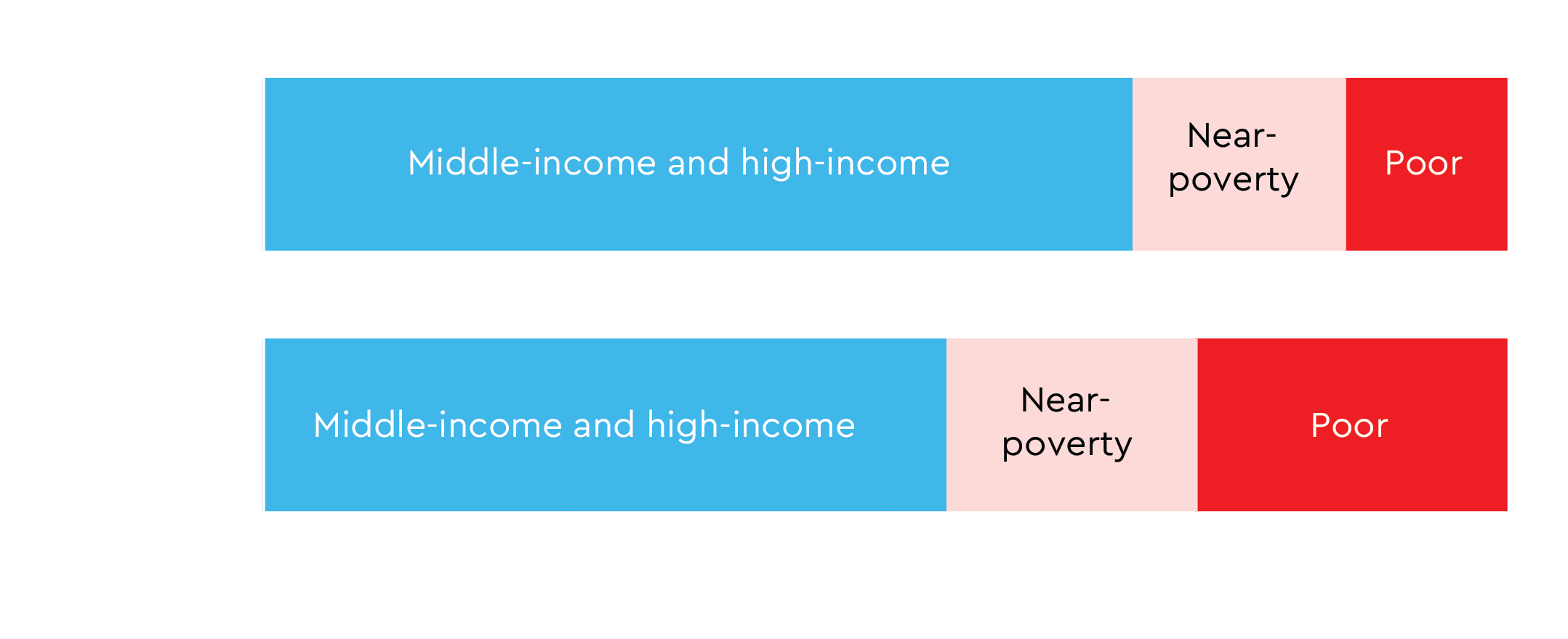
Percentage of Families with Children by Household Income Category
East Baton Rouge Parish Compared to the U.S. Average, 2024
Source: Common Good Labs analysis of data from the U.S. Census Bureau Public Use Microdata Sample.
* Middle-income and high-income households are equivalent to those earning 200% or more of the federal poverty threshold, near-poverty households earn above 100%, but less than 200%, and households in poverty earn less than 100%.
These income groups are not evenly distributed across East Baton Rouge Parish as the map on the following page illustrates. Higher-earning households tend to be most common in St. George, Zachary, Central, and unincorporated rural parts of the parish.11 They are also concentrated in neighborhoods near the center of Baton Rouge, such as Bocage and Southdowns.12
The parish’s income distribution has shifted over time as population growth has occurred primarily outside the historic urban core. These patterns have implications for school enrollment and the local tax base. There are now many fewer children in the older parts of the city where many of the largest schools were built in the 1960s and 1970s, for example.13
As the population of middle-income and high-income families has shifted toward the southeastern part of the parish, retail businesses downtown and in historic neighborhoods around mid-city have fewer customers nearby. Families in poverty and near-poverty families tend to be concentrated in the oldest residential areas of the parish.14 This includes communities along the northern stretches of Airline Highway as well as historic neighborhoods that were bisected by interstate construction in the 1960s.15
The differences between income groups shape more than just where families tend to live. The next two sections examine what life is like for higher-earning households as well as families in poverty and near-poverty in the parish.
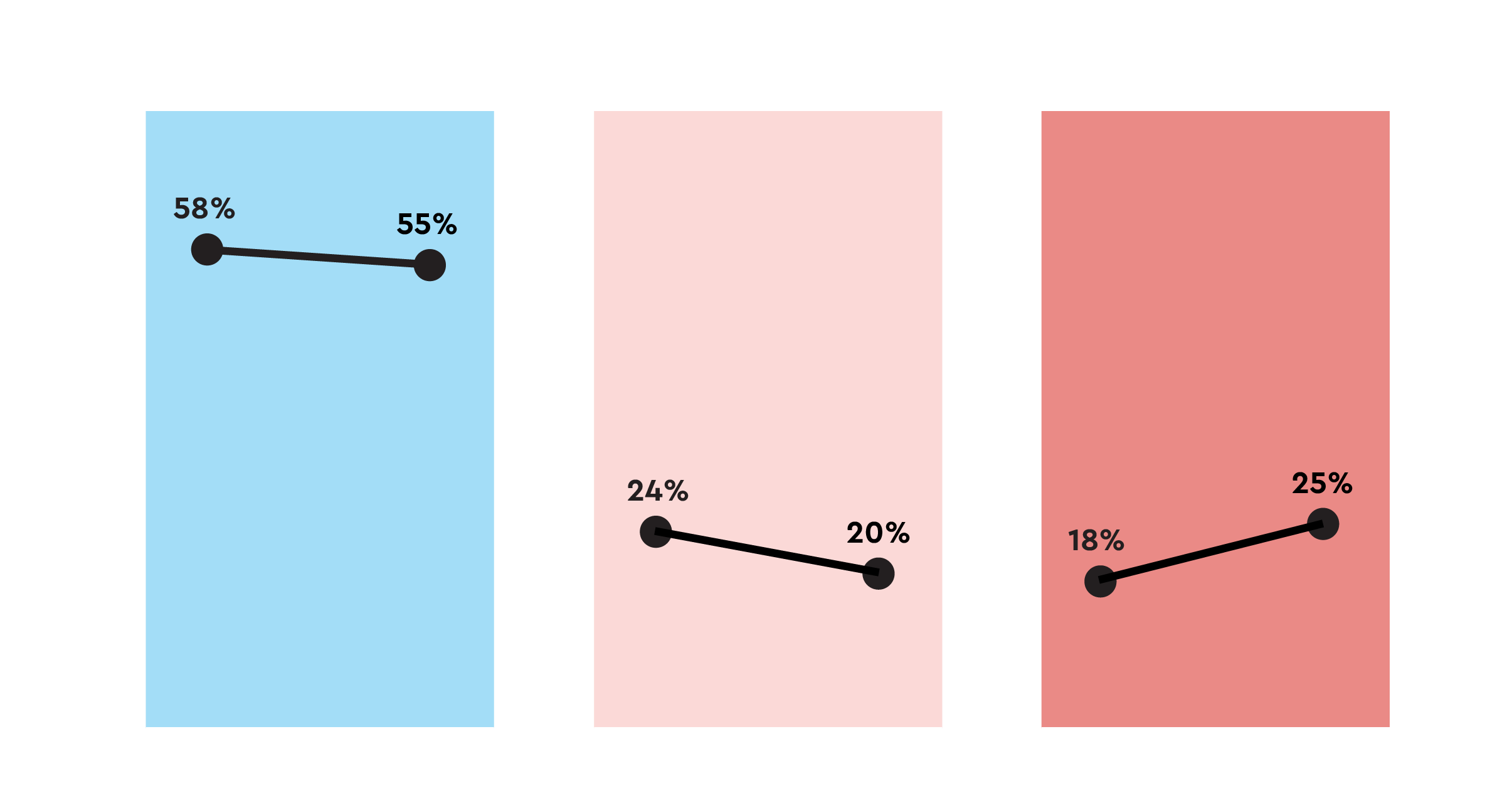
Percentage of Families with Children in East Baton Rouge Parish
Comparison between 2014 and 2024
Source: Common Good Labs analysis of data from the U.S. Census Bureau Public Use Microdata Sample. Facing page: Common Good Labs estimates based on data from the U.S. Census Bureau’s American Community Survey. Middle-income and high-income households are equivalent to those earning 200% or more of the federal poverty threshold, near-poverty households earn above 100%, but less than 200%, and households in poverty earn less than 100%.
Middle-income and high-income families in the parish tend to have stable employment, retirement savings, and children in high-performing schools.
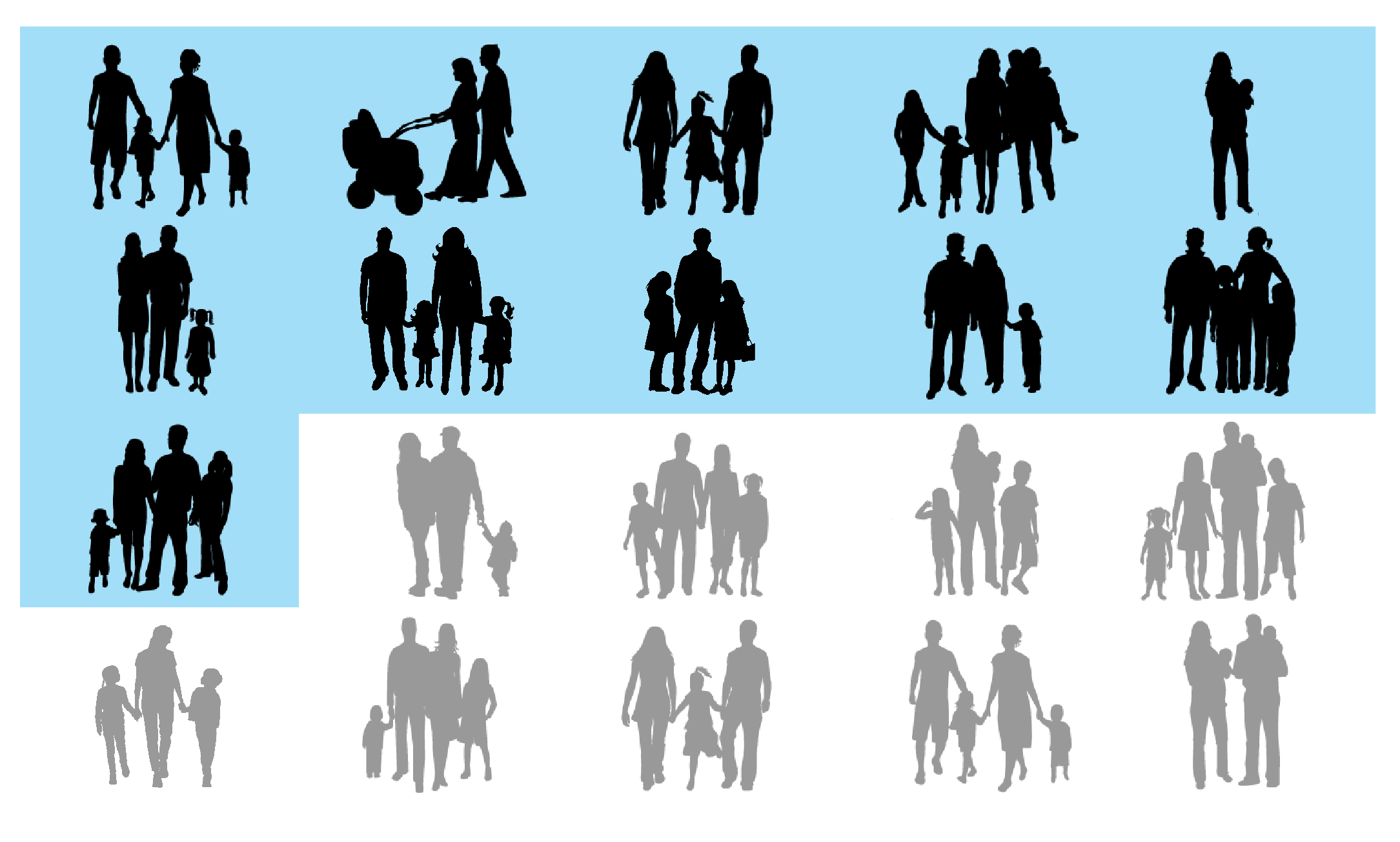
Most families with children in East Baton Rouge Parish are middle-income and high-income families. Around 55% of local families with children fall into this group, which is below the national average of 70% but still represents the largest share of families in the parish.16
Data indicates that around 38% of local families with children are high-income households, with earnings of around $100,000 or more for a family of four.17 And, 18% are middle-income households with earnings roughly equal to $70,000 to $100,000 for a similarly sized family.18
The households in these middle-income and higher-income groups have grown more diverse in recent decades with significant increases in the number of Black and Hispanic residents. Today, approximately one-in-ten families in this group are Asian, one-in-ten are Hispanic, around one-third are Black, and about half are White.19
Parents in these families are more likely to work in industries such as health care, education, finance, and professional services (e.g., architecture and law).20 These sectors tend to
offer higher wages, stable career paths, and earnings that grow over time. They also have larger numbers of credentialed occupations, such as medical doctors and civil engineers, that provide job security through professional licenses.21 Around one in ten parents within these families own small businesses, many of which have employees and generate significant income for their owners.22
The stability these jobs provide allows most of these families to build savings. Local surveys show that the majority of these households are saving for retirement and have emergency funds they can draw on when needed. About 79% of these families also own their homes, which provides both a stable place to live and a long-term financial asset.22
Middle-income and high-income families in the parish tend to have one to two children, usually between 6 and 17 years old.24 Around 65% of these children attend public schools, often in highly rated magnet programs such as Liberty, Baton Rouge High, and McKinley Middle, or in smaller districts such as Zachary and Central.25 The remaining third attend private schools or are homeschooled.26
Proportion of Families with Children That Are Middle-Income and High-Income
East Baton Rouge Parish, 2024
Source: Common Good Labs analysis of data from the U.S. Census Bureau Public Use Microdata Sample
Local families in poverty or near-poverty tend to have
parents who work in less secure industries and children
who attend lower-performing schools.
East Baton Rouge Parish has a very high proportion of families in poverty and near-poverty compared to similar parishes and counties in the United States. Among the primary counties of the 100 largest metro areas in the nation, East Baton Rouge has one of the largest percentages of families in these two lower-income groups, as the chart below illustrates.27
About 45% of families with children in East Baton Rouge are currently poor or near-poverty, with 20% classified as near-poverty and 25% classified in poverty.28 This has a significant impact on the youngest residents in
the community. Nearly one in three children in the parish currently live in families in poverty.
The demographics of this group are also different from those of middle-income and high-income families. Less than 10% of families in poverty or near-poverty are Asian, less than 10% are Hispanic, about 20% are White, and just over 70% are Black.29
Parents in these families are more likely to be unemployed or work in jobs that offer less stability and fewer career paths that build earnings over time. The industries they work in tend to offer lower wages and less

Percentage of Families with Children Who Are Poor or Near-Poverty
Primary Counties of the 100 Largest U.S. Metropolitan Areas, 2024
Source: Common Good Labs analysis of data from the U.S. Census Bureau Public Use Microdata Sample.
predictable schedules, such as retail, food service, health services, and construction.30 National data suggests that around 10% of adults in these families own small businesses, though these firms tend to be much smaller than those owned by higher-income families and generally have few or no employees.31
Local surveys also show that the majority of households in poverty or near-poverty do not have retirement savings and lack emergency funds they can draw on when needed. Less than half of these families own their homes, while 54% rent.32 Housing costs weigh heavily on these renters. Nearly half are severely rent-burdened, meaning the majority of their income goes toward paying for housing.33
Many have limited transportation options. While over 80% of these families own an automobile, reaching the workplace, school, or health care facilities may be difficult for the remaining families who do not have a car.34
Large numbers of families in poverty also worry about having enough food for their children, and many were affected by recent temporary cuts to programs like SNAP. The vast majority rely on federal programs to access health care.35 Families classified as near-poverty may sit above the federal poverty threshold, but many still struggle to cover basic living costs. A single job loss, unexpected medical bill, or major car repair can push them into poverty.
Families in poverty or near-poverty have two or more children per household, on average.36 Most also have at least one child under six.37 This can put significant pressure on their incomes since these families are around four times more likely to be led by a single parent and child-care costs in the parish are high relative to their earnings. Federal data indicates that it costs local families around $8,000 per year to send an infant or toddler to a full-time child-care center.38
Over 80% of school-aged children in these families attend public schools, and they are much more likely than the children from higher-earning families to be enrolled at schools rated C, D, or F by the Louisiana Department of Education.39
So, how can civic leaders in Baton Rouge help families in poverty or near-poverty move up the economic ladder? The final section of this report examines evidence from other communities.
Conclusion
Data from other communities provide examples of strategies and programs for increasing prosperity among local families. These examples show that improving economic mobility is possible for places like East Baton Rouge. They also highlight key mechanisms for boosting economic mobility among households.
One of the first things they illustrate is that middle-income and higher-income families can remain prosperous. Adults in these households within the parish tend to have college degrees or professional credentials that support higher wages and stable careers. These workers are well-positioned to benefit from the economic growth forecasted for the Capital Region.40 However, it is important that the community provides strong schools and a high quality of life to ensure that these economically successful families and their children who grow up locally are more likely to choose to remain in East Baton Rouge.
Evidence also suggests that the following strategies can help local families in poverty and near-poverty build lasting prosperity.
Increase educational attainment among young adults. Helping more young adults earn college and community college degrees is one of the strongest levers for moving families up the economic ladder.41 Parish data shows that workers with postsecondary credentials earn significantly more over their lifetimes than those with only a high school diploma.42
Support apprenticeships and employer-based training. Apprenticeships and employer-based training can connect workers without four-year degrees to higher-wage jobs.43 These programs can be particularly valuable for parents who cannot leave the workforce to attend school full-time, and tend to be most successful in communities like Baton Rouge that already have thriving industrial sectors.
Expand early childhood development and affordable child care. High-quality early childhood programs and affordable child care can help build a foundation for children’s long-term success and they support workforce participation among parents.44 This is especially important in East Baton Rouge, where most families in poverty or near-poverty have a child under the age of six.
Assist small businesses among self-employed residents. Programs that provide targeted support to self-employed workers and part-time business owners can help local small businesses to thrive and grow.45 These initiatives can benefit the thousands of lower-income families who own their own companies.
Make housing more affordable. Nearly half of lower-income renters in East Baton Rouge Parish are severely rent-burdened, meaning the majority of their income goes toward housing. Communities across the country have adopted a range of approaches to reduce housing costs, including increasing the supply of affordable rentals and supporting first-time homebuyers with down payment assistance.46
Baton Rouge contains both prosperity and challenge. However, it is important to note that income levels are not fixed over time. The strategies outlined above can help middle-income and higher-income families to remain prosperous, and provide upward mobility to families in poverty or near-poverty. Each connects to the work already underway following previous Opportunity Data Project briefs on early childhood development, school engagement, public safety, and community health.
Bailey and Dynarski, Gains and gaps: Changing inequality in U.S. college entry and completion. NBER Working Paper No. 17633; Chetty et al., Where is the land of opportunity? The geography of intergenerational mobility in the United States. Quarterly Journal of Economics.
Looney and Turner, Work and opportunity before and after incarceration. Brookings Institution.
https://www.brookings.edu/articles/work-and-opportunity-before-and-after-incarceration/.Gershoff et al., Income is not enough: Incorporating material hardship into models of income associations with parenting and child development. Child Development.
Kornrich, Inequalities in parental spending on young children. AERA Open.
Acs et al., Identifying pathways for upward mobility. Urban Institute.
https://www.urban.org/research/publication/identifying-pathways-upward-mobility.Common Good Labs analysis of data from the U.S. Census Bureau.
ALICE in Focus, 2022. United for ALICE. https://unitedforalice.org/focus-children.
Morduch and Siwicki. In and Out of Poverty: Episodic Poverty and Income Volatility in the US Financial Diaries.
Social Service Review.Common Good Labs analysis of data from the U.S. Census Bureau Public Use Microdata Sample.
Ibid.
Common Good Labs analysis of data from the U.S. Census Bureau’s American Community Survey.
Ibid.
Common Good Labs analysis of data from the U.S. Census Bureau’s Decennial Survey and American Community Survey.
Common Good Labs analysis of data from the U.S. Census Bureau’s American Community Survey.
Ibid.
Common Good Labs analysis of data from the U.S. Census Bureau Public Use Microdata Sample.
Ibid.
Ibid.
Ibid.
Ibid.
Ibid.
Common Good Labs estimate.
Common Good Labs analysis of data from the U.S. Census Bureau Public Use Microdata Sample.
Ibid.
Common Good Labs analysis of data from the U.S. Census Bureau Public Use Microdata Sample and the East Baton Rouge School System.
Common Good Labs analysis of data from the U.S. Census Bureau Public Use Microdata Sample.
Ibid.
Ibid.
Ibid.
Ibid.
Common Good Labs estimate.
Common Good Labs analysis of data from the U.S. Census Bureau Public Use Microdata Sample.
Ibid.
Ibid.
Ibid.
Ibid.
Ibid.
Department of Labor, Childcare Prices by Age of Children and Care Setting 2022. https://www.dol.gov/agencies/wb/topics/childcare/price-by-age-care-setting-2022.
Common Good Labs analysis of data from the U.S. Census Bureau Public Use Microdata Sample and the East Baton Rouge School System.
Louisiana Economy Forecasting Model, LSU Department of Economics. https://www.lsu.edu/business/economics/la-forecasting.php.
Carnevale, Cheah, and Wenzinger, The College Payoff: More Education Doesn’t Always Mean More Earnings. Georgetown University Center on Education and the Workforce, 2021. https://cew.georgetown.edu/cew-reports/collegepayoff2021/.
Common Good Labs analysis of data from the U.S. Census Bureau’s American Community Survey.
Reed et al., An effectiveness assessment and cost-benefit analysis of registered apprenticeship in 10 states. Mathematica Policy Research.
https://www.dol.gov/sites/dolgov/files/ETA/publications/ETAOP_2012_10.pdf.García et al., Quantifying the life-cycle benefits of an influential early childhood program. NBER Working Paper No. 23479; Morrissey, Child care and parent labor force participation: A review of the research literature. Review of Economics of the Household.
Chrisman, Economic impact of Small Business Development Center counseling activities in the United States: 2018-2019. America’s SBDC.
https://americassbdc.org/about-us/economic-impact/.Increasing the affordability of rental housing. Local Housing Solutions. https://www.localhousingsolutions.org/policy-objectives/increasing-the-affordability-of-rental-housing/; Local Housing Solutions, Down Payment and Closing Cost Assistance.
https://www.localhousingsolutions.org/housing-policy-library/downpayment-and-closing-cost-assistance/.